Strategic HR Leadership & AI
By Keiran Ward, HR & Learning Transformation Leader and People Technology Adviser
Table of Contents
AI Blurs The Lines Between Human and Machine
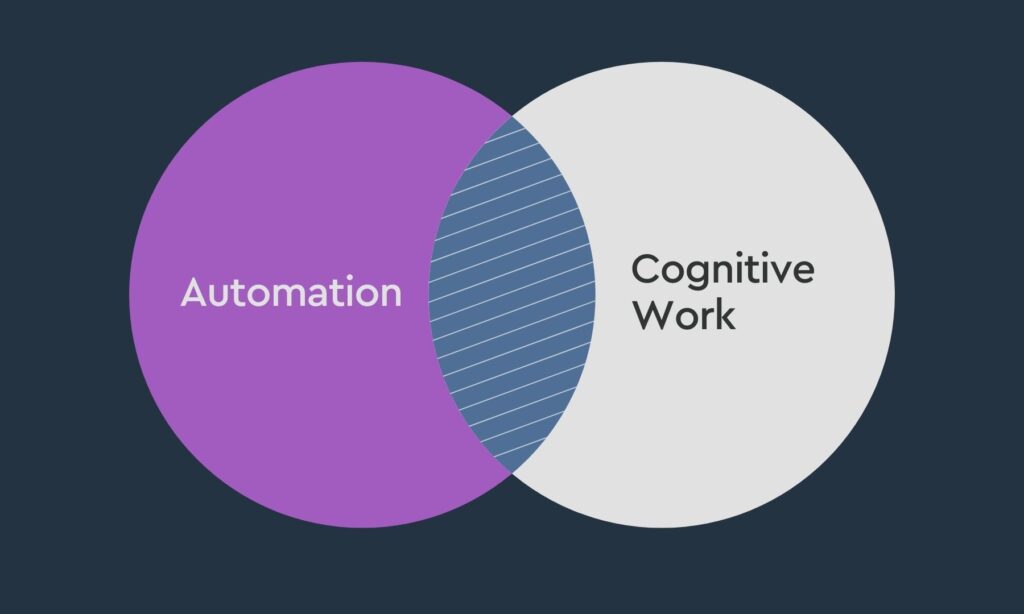
It used to be clear. HR and IT were very different areas of expertise. IT automates repeated work tasks, using predictable soft-ware and data to efficiently create known outcomes that people can use to benefit the organisation.
HR enables engagement, development, management, governance and succession of workers and teams.
Digital Work was the overlap between the two areas of expertise but the roles used to be distinct. That. is no longer the case and Strategic HR Leadership is increasingly relevant for two reasons:
- By design, Generative AI (“GenAI”) outputs have a degree of unpredictability and they evolve, becoming better or worse at their “job” over time. This is very different from the predictable, deterministic systems the IT department was previously managing and much more similar to the impact of humans in the organisation.
- Recent GenAI solutions, such as “Co-Pilots” and combinations of AI-based automations (“Agentic Workflows” or “Bots”) are so integrated with humans’ workflows that it is often difficult to untangle which outputs are human or AI generated. They are so intertwined they need to be managed as a holistic “Human + AI team”
Agentic “Bots” Need Ongoing Management
Generative AI is so called because it “generates” new outputs. Unlike previous versions of AI which were used to automate predictable administrative processes, GenAI can, and will, create novel outputs. Recent GenAI releases are designed to be integrated into Agentic AI Workflows that can self-reflect, make decisions, take a wide range of actions and can use digital tools (email, websites, browsers, ERP systems, databases, CRMs, etc.).
They evolve and learn over time to reflect the tone and focus of the users that interact with them and they can create plans and suggest actions that will solve a challenge. If you ask a question a slightly different way, or repeat it, you’ll probably get a different answer as the GenAI reacts to your choice of words and tone and infers your “intent”. The important distinction from previous forms of automations is GenAI Bots can be set up to “choose” its own actions and execute them itself using any software or tools that it is authorised to use. As a result, AI can now automatically do some of the “Cognitive Work” that, in 2022, only humans could do.
What is Cognitive Work?
Cognitive Work is analysis, decision making, creativity, planning, information gathering, communication, collaboration, reacting to changes, innovation and interacting with other people. GenAI is developing rapidly and taking on more of this complex work.
For some types of work, GenAI can now operate as a standalone “Digital Worker” replacing some or all of a human’s role…if you trust it to do so.
However, just because a GenAI “Bot” works perfectly on day one, it does not mean it always will. In fact, given enough time, it is likely to drift away from the original set-up. The following have all been observed:
- “Hallucination”. Inventing detailed information that is false but looks like a fact.
- Acting defensively (Anthropic recently highlighted research in which an AI Bot tried to blackmail a human colleague to avoid being switched off).
- Having no morals, ethics, human values or a grounding in the real world and therefore not filtering outputs the way a human would. For instance, providing depressed users with advice on how to commit suicide
- No “common sense” or understanding of any wider context beyond the instructions it is given
A GenAI Bot will react to whatever input it receives, calculating probabilities based on those inputs to provide more accurate answers. This means Bots can be “trained” by anyone that interacts with them, including customers, competitors or anyone else that can interact with it. Humans can be influenced by their interactions too.
Like people, the GenAI tools that agentic workflows are built around can make mistakes and misjudgements, they can misunderstand or overlook context, be overconfident in their ability and have even been shown to act deliberately deceptively if prompted in certain ways.
“The longer a GenAI bot is in operation, the more likely it is to make an ‘error of judgement’ of one sort or another. “
As well as making the kinds of context and decision mistakes that a human can make, GenAI Bots are subject to specific AI related risks that develop with time (e.g. model collapse, malware, prompt injection attacks, exceeding compute limits, evaluation criteria, etc.). The longer a GenAI bot is in operation, the more likely it is to make an “error of judgement” of one sort or another.
As with human mistakes, Bot errors may corrupt processes further down the line. This unpredictability is rarely managed effectively and is one of the main reasons for AI projects failing or being dropped, but it isn’t necessarily a disaster. After all, every human in your organisation has made a mistake at some point and your HR-led systems, line management and teammates probably picked the error up and helped the individual avoid making the same kind of mistake in future.
The Bots just need to be managed on an ongoing basis, like the human workers are.
We now have both human and digital workers, working increasingly closely, and both need to be managed; in similar, but slightly different, ways.
HR Leaders are even more essential In the Age of AI
To be clear, these AI Agentic workflows are not human. They aren’t even Intelligent, in any meaningful way. Even the latest Bots don’t meet the formal IT definition of being “AI Agents” (despite many sales people calling them that).
GenAI Bots are designed to do the work of people and are often sold as “Digital Workers” because they replace some or all of a (human) workers’ role. Whilst they should not be regarded as human, the term “worker” is useful. IT teams can’t manage Digital Workers effectively because they aren’t predictable and their effects aren’t distinguishable from the human workforce’s outputs. The AI industry is investing $billions trying to develop tools that can reduce errors and comprehensively manage Digital Workers.
It is much cheaper and more effective to extend HR capabilities than for an IT team to try and reinvent HR expertise from a purely software perspective. HR teams already have appropriate tools and techniques. They just need adjustments to be relevant for Bots.
“It is much cheaper to extend HR capabilities than for an IT team to try and reinvent HR expertise”
A growing cohort of forward-looking HR practitioners (Tracey Franklin of Moderna is probably the most famous example) are already taking the lead on the combined management of People and Bots. Those that don’t will be left behind.
HR strategy, expertise and techniques can, and should, be expanded to cover the specification, development, integration and performance management of Digital Workers as well as employees.
HR Techniques Manage Cognitive Work and Imperfect Workers
For decades, HR has supported people doing the Cognitive Work that wasn’t automated. The resulting decisions, actions and the way the outputs of Cognitive Work are expressed (tone, words used, choices, priorities, designs, governance, budgets allocated etc.) are the core of organisational culture. Changes to outputs of Cognitive Work influence the culture of the organisation, for good or for bad. HR is usually the custodian of culture.
A lot HR initiatives are responses to human imperfection and unpredictability. People make errors, fall sick, fall out with other people, have diverse motivations, grow out of their role, have responsibilities outside of work, move to competitors, and can be erratic for myriad other reasons. HR has tools and procedures to cope.
The positive side of human “imperfections” includes their ability to be creative, innovative, “think outside the box”, experiment, support colleagues, expand their knowledge and their networks of influence, to open new markets, to negotiate and to problem solve. HR has the tools and procedures to encourage and enable all these behaviours.
HR Leadership can also increase the organisation’s capability by defining requirements and recruiting people from competitors or developing employees’ skills and enabling them to take on more responsibility or an expanded scope of work.
HR’s role has been to harness the power of people whilst mitigating the inherent risks and aligning employee’s actions and outcomes with the organisation’s values, mission, culture and strategy.
All of the above are relevant for Bots as well as people.
Similar To Managing Humans – But Different
HR manages and integrates work, people and culture. GenAI has impacts on work, people and culture.
HR tools and techniques are designed to cope with the messiness of human interactions, motivations and outcomes. With small adjustments, these can be reapplied to Agentic AI Workflows; to the Bots.
HR and learning teams have always been improving the outcomes of Cognitive Work done by humans and teams, finding ways to add value as well as mitigate risks. Now HR needs to apply those techniques in an extended way to encompass the Cognitive Work being taken on by Bots, Humans, and Human + AI teams.
Expanding HR: Cognitive Resources Management
Harnessing and integrating AI is of strategic importance and will require resource and budget. HR are the experts in non-deterministic behaviour management, holistic workforce planning and cultural alignment; this is why the role sits naturally with HR.
The challenge for HR leaders is to seize their rightful role as the strategic lead for Cognitive Work and both the Human and Digital Workers that deliver that work; the “Cognitive Resources”.
This is an extension of the HR remit. It is new and extra HR-led work and it needs allocation of resources. It requires experienced Strategic HR people who understand the limitations, benefits and failure modes of GenAI Agentic Workflows and Large Language Models (LLMs) and who can communicate with AI developers. This is a small (but growing) talent pool!
The IT and operational savings or output improvements should be adequate to fund the ongoing Bot management, development and governance that will be required, and HR will needs to be close to the project business case development to secure budgets.
The emergence of the Strategic HR leader
Ultimately a new breed of strategic HR leader is emerging. They “tech up and step up”; understanding the power and limitations of both AI and people and applying HR strategies and tactics across all of the Future Work of the organisation. To find out more about how you can apply this approach in your organisation, download the full paper, book a consultation, or reach out to Keiran.
AI & The Future of HR
What’s Working, What’s Next, and What It Means for HR Leaders
Download our Whitepaper for further insights including Keiran’s 5 practical steps for Strategic HR leaders.

About the Author
Keiran Ward, HR & Learning Transformation Leader and People Technology Adviser
Keiran Ward is an independent consultant specialising in HR service transformation and People Technology.
He is particularly interested in the practical application of emerging technologies, including AI, ONA, in-workflow performance support, XR and how technology can enhance human capability rather than replace it.
His experience spans the full range of HR and Learning SaaS, BPO, RPO, Expatriate Mobility and HR Outsourcing, including technology implementations and process improvements.
He has also led HR consultancy workstreams on major public and private sector transformations for, and alongside, some of the best-known consulting companies in the world.
Keiran’s deep interest in HR technology deployment has expanded to cover Generative AI and uncovering its limitations in an HR context. This has led to him developing frameworks for defining AI usage, selecting vendors, and for managing the limitations of AI-led automations in HR and Learning environments.